
Hammertoe Correction
Straighten the toe. Restore the Contour. Fixing Feet Beautifully®.
We don’t just fix the bone. We care deeply about the overall beauty, balance, and natural contour of your foot.
At Foot First Podiatry, many of our patients come to us frustrated by painful or unsightly hammertoes - whether it’s a rigid hammertoe, a painful joint, or toes that are curling, crooked, or contracted.
A hammertoe is more than a bent toe. It can create painful pressure, rubbing in shoes, recurring corns, and a contracted appearance that disrupts the natural contour of the entire foot.
You may already know that we revolutionized bunion treatment with The Sklar Bunionectomy®, an approach designed around structural stability, immediate weight-bearing, hidden incisions, and natural-looking cosmetic results.
We bring that same philosophy to hammertoe correction and toe straightening.
WHAT IS A HAMMERTOE?
A hammertoe develops when an imbalance involving the muscles, tendons, ligaments, or joints causes a toe to bend or contract instead of resting in a naturally straight position.
Hammertoes most commonly affect the second, third, or fourth toes and may begin as flexible deformities before becoming increasingly rigid over time.
As the toe contracts, the raised joint can repeatedly rub against shoes while the tip of the toe may press downward against the ground. This abnormal pressure can lead to:
Painful corns and calluses
Joint irritation and inflammation
Difficulty wearing shoes comfortably
Redness and rubbing over the toe
Pain beneath or at the tip of the toe
Progressive stiffness or rigidity
Open sores in more severe cases
Cosmetic concerns about crooked or contracted toes
Some hammertoes remain relatively flexible. Others eventually become rigid and cannot easily be straightened without surgical correction.
BEAUTY MEETS FUNCTION
We don’t believe you should have to compromise the appearance of your foot to correct its function.
Our approach to hammertoe surgery considers more than simply straightening one toe. We evaluate how that toe relates to the adjacent toes, the overall shape of the forefoot, and the natural contour we are trying to restore.
Through our specialized surgical techniques, we can straighten, realign, and uncurl contracted toes while addressing the structural problems contributing to the deformity.
Immediate Weight-Bearing
Our surgical techniques and internal stabilization are designed to allow patients to bear weight immediately after surgery in a protective surgical shoe, depending on the procedures performed.
No Casts or Crutches
Most patients recover without the burden of a heavy cast or crutches.
Hidden Incisions
We do not place our hammertoe incisions on top of the toes. Our incisions are strategically hidden on the bottom or side of the toes, rather than across the visible top surface.
Internal Stabilization
There are no pins sticking out of your toes. When fixation is necessary, our stabilization remains completely inside the toe rather than leaving traditional surgical pins or wires protruding from the ends of the toes.
The goal is simple: restore function while creating a straighter, smoother, more natural-looking foot.
WHAT IS HAMMERTOE CORRECTION?
Hammertoe correction surgery is designed to realign a toe that has become bent, curled, or contracted.
But at Foot First, we look beyond the individual joint.
Our goal is to determine why the toe is contracting, correct the underlying structural problem, and restore the toe to a position that works naturally with the rest of your foot.
Depending on the type and severity of the hammertoe, correction may involve releasing or balancing tight tendons, correcting the contracted joint, repositioning the toe, and stabilizing the correction internally while healing occurs.
The objective is not simply a straighter X-ray.
It is a toe that is better aligned, more comfortable in shoes, and naturally proportioned relative to the adjacent toes and the rest of the foot.
THE FOOT FIRST DIFFERENCE
WE TREAT THE FOOT, NOT JUST THE HAMMERTOE.
A hammertoe rarely exists in isolation.
Bunions, long or short toes, abnormal pressure patterns, tendon imbalance, painful corns, and neighboring toe deformities can all influence the appearance and function of the forefoot.
That is why we evaluate the entire foot before planning your correction.
Using our specialized Foot First approach, we address tight tendons and contracted joints, realign the toe, and use internal stabilization when necessary to maintain the correction during healing.
Just as importantly, we consider how the corrected toe will look alongside the neighboring toes.
We want to create a smooth, balanced, natural profile across the entire foot - reducing painful rubbing while improving the overall appearance of the toes.
Fixing one toe without considering the rest of the foot can solve one problem while creating another.
Function matters. Proportion matters. Beauty matters.
HIDDEN INCISIONS
WE HIDE OUR INCISIONS.
We do not place our hammertoe incisions on top of the toes.
Our incisions are strategically placed on the bottom or side of the toes, rather than across the visible top surface.
Traditional hammertoe surgery may leave a visible incision or scar over the top of the corrected joint. Our approach is different. Cosmetic appearance is an important part of what we do, so we deliberately position our incisions in less visible locations when performing our hammertoe correction technique.
The goal isn’t simply to straighten your toes. It’s to straighten them without leaving a surgical incision across the top of the toe.
No incision on top. Hidden incisions on the bottom or side. A cleaner, more natural-looking result.
HIDDEN INTERNAL FIXATION
NO PINS STICKING OUT OF YOUR TOES.
Traditional hammertoe surgery may involve temporary wires or pins that extend from the ends of the toes during the healing process.
We do things differently.
At Foot First, there are NO pins sticking out of your toes.
When fixation is required, our approach uses internal stabilization. The fixation remains completely inside the toe, allowing the correction to be supported without traditional pins or wires protruding from the ends of the toes.
No exposed pins. No wires sticking out of your toes.
This internal support is designed to provide stability while the corrected toe heals and helps create a cleaner and more comfortable recovery experience.
There are no exposed pins to catch on clothing or bedding, and patients do not have to look down and see wires extending from their toes during recovery.
It’s another example of how we think beyond simply correcting the deformity.
We consider the entire patient experience - from the operating room through recovery and the final cosmetic result.
The correction is internal. The pins stay hidden.
BEFORE & AFTER
HAMMERTOE CORRECTION IS ABOUT MORE THAN MAKING A TOE STRAIGHT.
Successful correction should restore harmony to the entire forefoot.
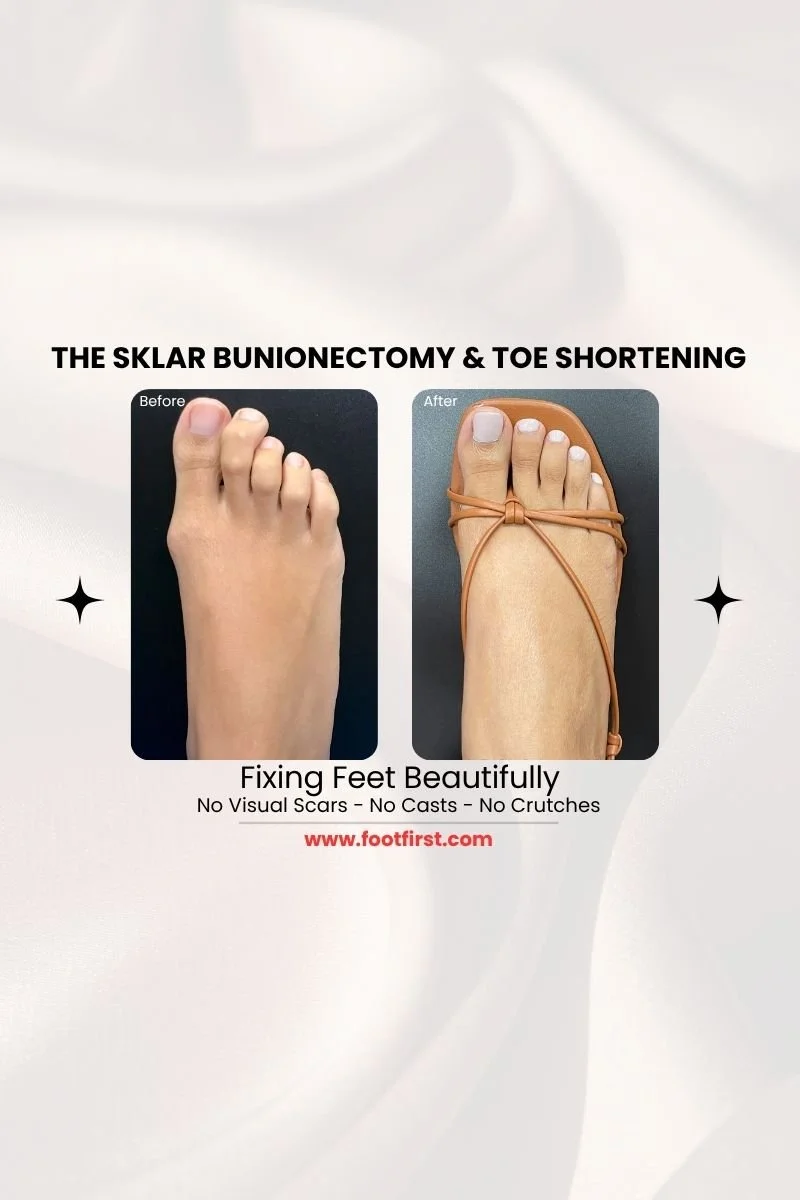
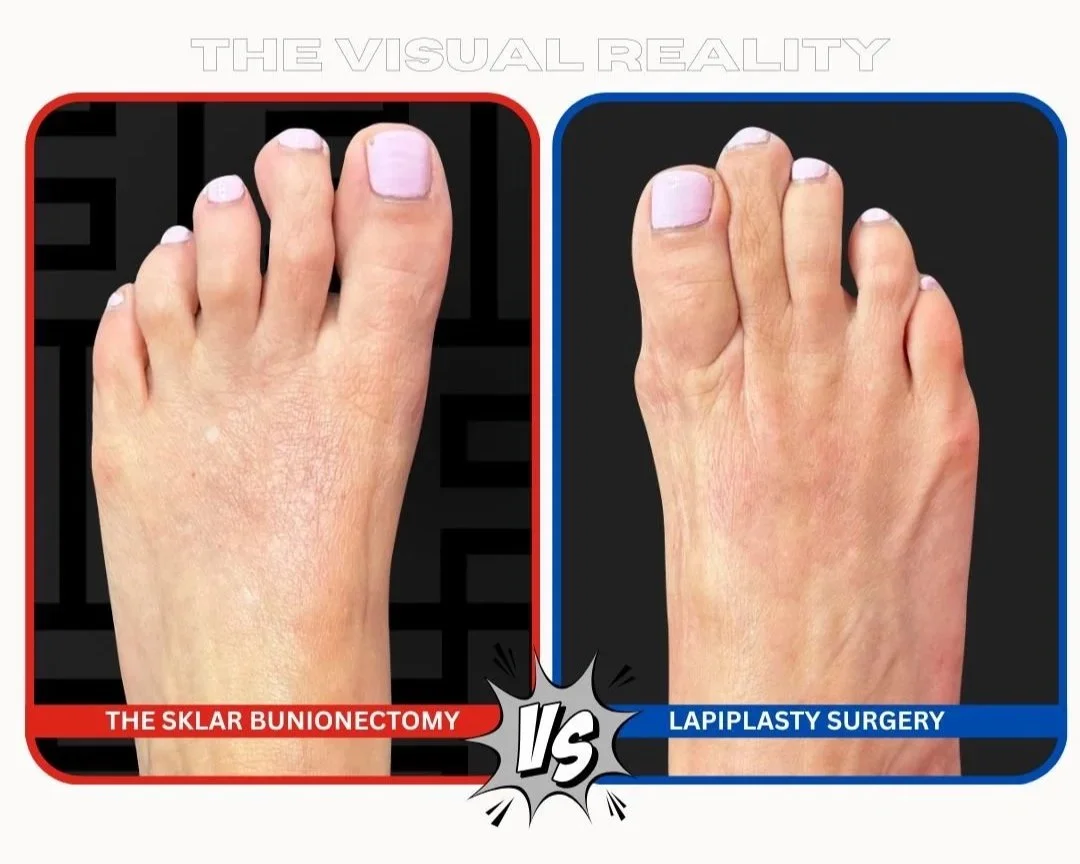
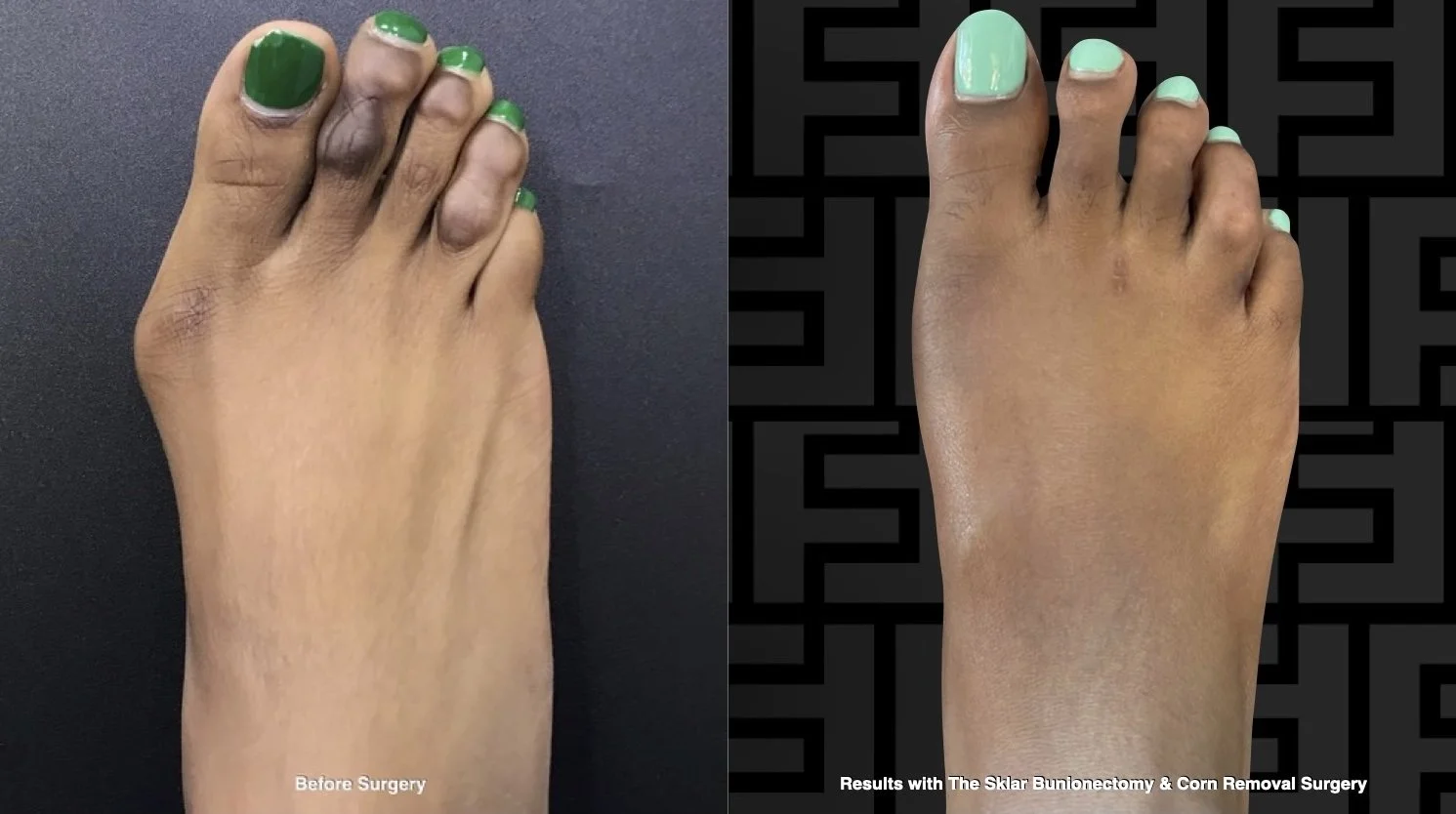
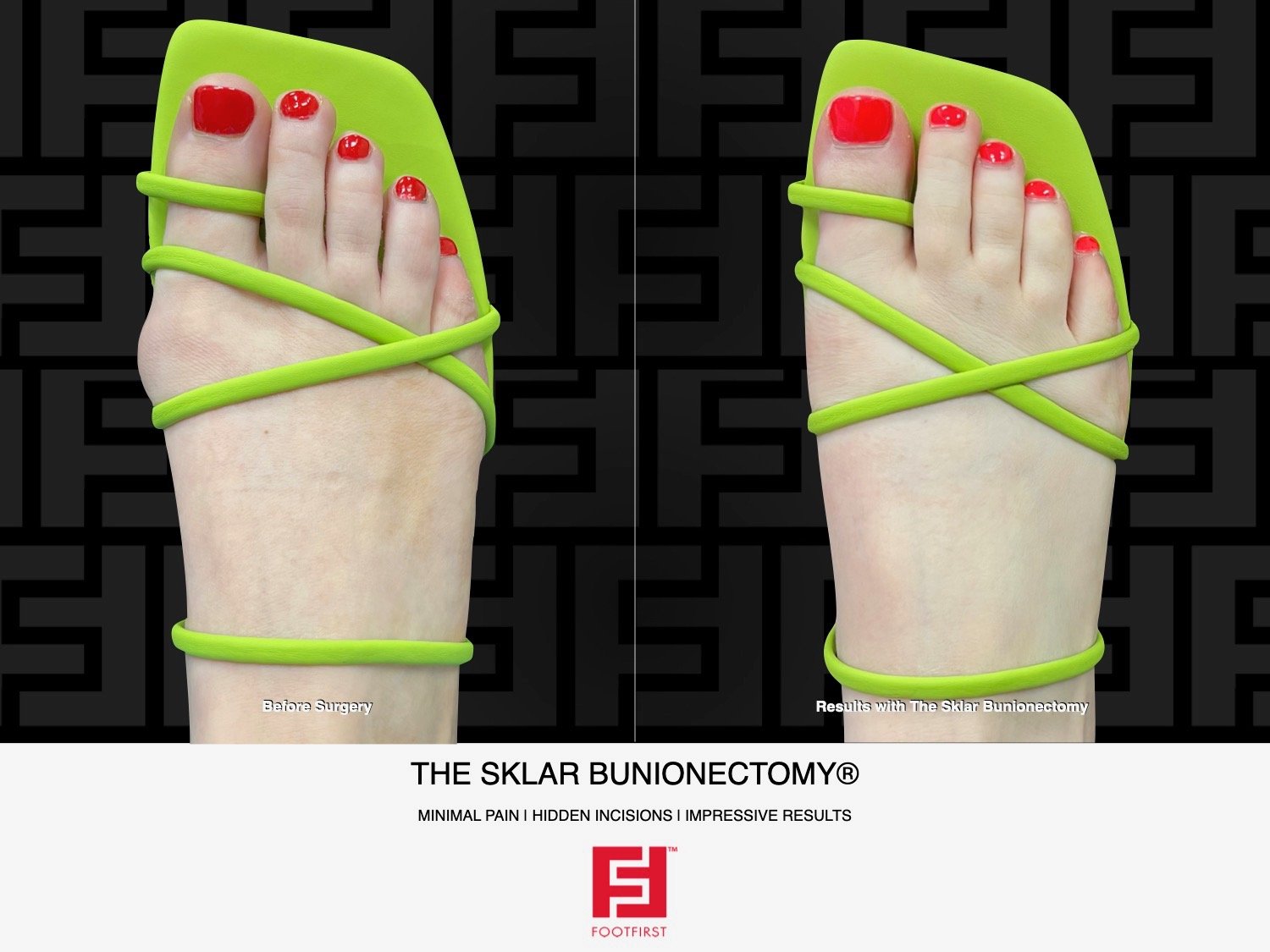
Our before and after results demonstrate how correcting contracted toes - alone or in combination with bunion correction and other procedures - can improve alignment, reduce prominent joints and painful pressure points, and create a smoother, more natural-looking foot contour.
REAL TALK: THE AESTHETIC EVOLUTION
We believe patients deserve realistic expectations about recovery.
Let’s be completely honest: we aren't perfect, but we are really good at what we do. Our results speak for themselves - but a refined aesthetic transformation doesn’t happen by magic overnight.
Your foot will not look perfect immediately after surgery.
Structural correction takes place during surgery. Aesthetic refinement takes time.
During the first several weeks and months, swelling, bruising, discoloration, stiffness, and changes in the appearance of the toes are normal parts of the healing process.
We often tell our patients to anticipate what we jokingly call an “UGLY” transition period of approximately four months.
By “ugly,” we simply mean healing.
Your foot has undergone structural correction, and your body now needs time to repair tissue, reduce swelling, remodel, and reveal the final contour.
We call this process the Aesthetic Evolution.
As temporary swelling and discoloration gradually subside, the foot continues to change and refine. Many patients begin seeing significant cosmetic improvement around four months, while the final appearance can continue to mature for 6 to 12 months or longer, depending on the individual and procedures performed.
Your genetics, anatomy, procedure, activity level, and your body's individual healing response all influence this process.
Patience matters.
But healing doesn't necessarily mean putting your life completely on hold.
Our internal stabilization and surgical techniques are designed to provide structural support while allowing immediate protected weight-bearing after surgery for many patients.
Many patients are able to transition into an office approved supportive gym shoe around week 3, depending on the procedures performed and their individual healing.
Your recovery continues to evolve long after you have returned to many of your normal daily activities.
Structural correction happens in the operating room. Aesthetic refinement happens over time.
ADVANCED HEALING PROTOCOLS
Laser Therapy & Platelet-Rich Plasma (PRP)
Our care doesn't end when your surgery is finished.
At Foot First, we may incorporate advanced post-operative therapies into your recovery plan when appropriate, including Platelet-Rich Plasma (PRP) and Class IV Laser Therapy.
Platelet-Rich Plasma (PRP) Therapy
PRP uses a concentrated portion of your own blood containing platelets and growth factors and may be incorporated into your individualized treatment plan to support the body's natural healing response.
CLASS IV Laser Therapy
Laser therapy is used during recovery to help manage post-operative discomfort and inflammation and support the healing process.
These therapies are part of our broader philosophy: carefully manage the entire recovery - not simply the surgery itself.
HAMMERTOE CORRECTION QUESTIONS & ANSWERS
Will I have to miss work or stay off my feet?
That depends on your occupation, the procedures performed, and your individual recovery.
Our techniques are designed to allow many patients to bear weight immediately after surgery in a protective surgical shoe without crutches or a cast.
Patients with desk jobs may return sooner than patients whose occupations require prolonged standing, walking, lifting, or physical activity.
Many patients transition into an office-approved supportive gym shoe around week 3, although individual recovery times vary.
Will pins stick out of my toes?
NO. There are no pins sticking out of your toes.
At Foot First Podiatry, we use internal stabilization. Unlike traditional hammertoe techniques that may leave pins or wires protruding from the ends of the toes during recovery, our fixation remains completely inside the toe.
No exposed pins. No wires sticking out of your toes.
This is an important part of the Foot First approach to hammertoe correction. We want the correction to be structurally stable while also providing a cleaner and more comfortable recovery experience.
The correction is internal. The pins stay hidden.
Will there be an incision on top of my toes?
NO. We do not place our hammertoe incisions on top of the toes.
WE HIDE OUR INCISIONS.
Our incisions are strategically placed on the bottom or side of the toes, rather than across the visible top surface.
Traditional hammertoe surgery may leave a visible incision or scar over the top of the corrected joint. Our approach is different. Cosmetic appearance is an important part of what we do, so we deliberately position our incisions in less visible locations when performing our hammertoe correction technique.
The goal isn't simply to straighten your toes. It's to straighten them without leaving a surgical incision across the top of the toe.
No incision on top. Hidden incisions on the bottom or side. A cleaner, more natural-looking result.
Can you correct more than one hammertoe at the same time?
Yes. Multiple contracted or crooked toes can often be addressed during the same surgical procedure when appropriate.
Rather than evaluating each toe independently, we look at the relationship between the toes and the overall shape of the forefoot so the surgical plan creates a balanced result.
Can hammertoe surgery and bunion surgery be performed together?
Yes. When both conditions are present, they can often be corrected during the same surgical procedure, depending on the individual treatment plan.
We routinely combine The Sklar Bunionectomy® with hammertoe correction and toe realignment when both deformities are contributing to the patient's symptoms or the overall imbalance of the foot.
Correcting both problems together allows us to address the entire forefoot as one aesthetic and functional unit rather than treating each deformity separately.
Is hammertoe surgery only cosmetic?
No.
Patients seek hammertoe correction for many different reasons. Some are primarily concerned about pain, corns, shoe irritation, or difficulty walking comfortably. Others are bothered by the appearance of crooked, curled, or contracted toes.
Frequently, it is a combination of both.
At Foot First, we believe function and aesthetics belong together. Our goal is to create a foot that feels better, functions better, and looks naturally balanced.
HAMMERTOE + BUNION CORRECTION
SOMETIMES THE BEST RESULT REQUIRES LOOKING AT THE WHOLE FOOT.
A hammertoe may develop alongside a bunion, particularly when changes in the position of the great toe alter the space and pressure experienced by the lesser toes.
When both conditions are present, correcting only the hammertoe may not address the overall structural or cosmetic problem.
The Sklar Bunionectomy® can be combined with hammertoe correction, toe straightening, and other necessary forefoot procedures during the same surgical session.
The objective is comprehensive correction: restoring alignment while creating a foot that looks balanced, proportional, and natural.
READY TO LEARN MORE?
If you're considering hammertoe correction, hammertoe surgery, or toe straightening, the first step is a consultation with the doctors at Foot First Podiatry.
We'll evaluate your feet, discuss the concerns affecting your comfort, function, or appearance, answer your questions, and determine which treatment options are appropriate for you.
Whether you're seeking relief from painful hammertoes, correction of contracted or crooked toes, treatment for recurring corns, bunion correction, or improvement in the overall appearance of your feet, we'll develop an individualized treatment plan based on your anatomy and goals.
Patients travel to Foot First Podiatry from throughout Chicago, Illinois, the Midwest, and beyond for our approach to foot surgery and cosmetic foot correction.
If you're traveling from out of town, our team can help guide you through the consultation, surgical planning, and recovery process.
Your feet should function beautifully.
When you're ready, click on the button to request your consultation.
We look forward to helping you take the next step toward a healthier, more comfortable, and naturally beautiful foot.
QUESTIONS ABOUT HAMMERTOE SURGERY?
To learn more about Hammertoe Surgery and other treatments, check out our blog






Request a Consultation
Request a consultation by completing the form below, and we will contact you for scheduling.
We respond promptly to consultation requests, including evenings and weekends. If you don't see our reply in your inbox, please check your spam or junk folder.
Prefer to speak with us directly? Call (847) 352-9221.